Receding Hairline vs Thinning Crown in Men’s Hair Loss
Hair loss in men often begins at the hairline or the crown.
You might not notice at first, which is why many men struggle to work out what they are seeing or whether it is something to worry about.
By age 30, about 1 in 3 men show noticeable hairline recession. By 40, this increases to closer to half of men. And around 30-40% of men show some degree of crown thinning before turning 30, which rises steadily with age.
Keep reading as we break down the differences between a receding hairline and a thinning crown, how they typically develop and why you need to know what you’re dealing with when it comes to treatment and long-term management.
A receding hairline is when the front of the hair starts to move back, usually at the temples. A thinning crown happens at the top of the head, where hair slowly loses density and the scalp becomes more visible. They’re actually part of the same condition, but don’t always progress in the same way. For accurate diagnosis and treatment advice, speaking to an experienced hair specialist is usually the best next step.
What a Receding Hairline Looks Like
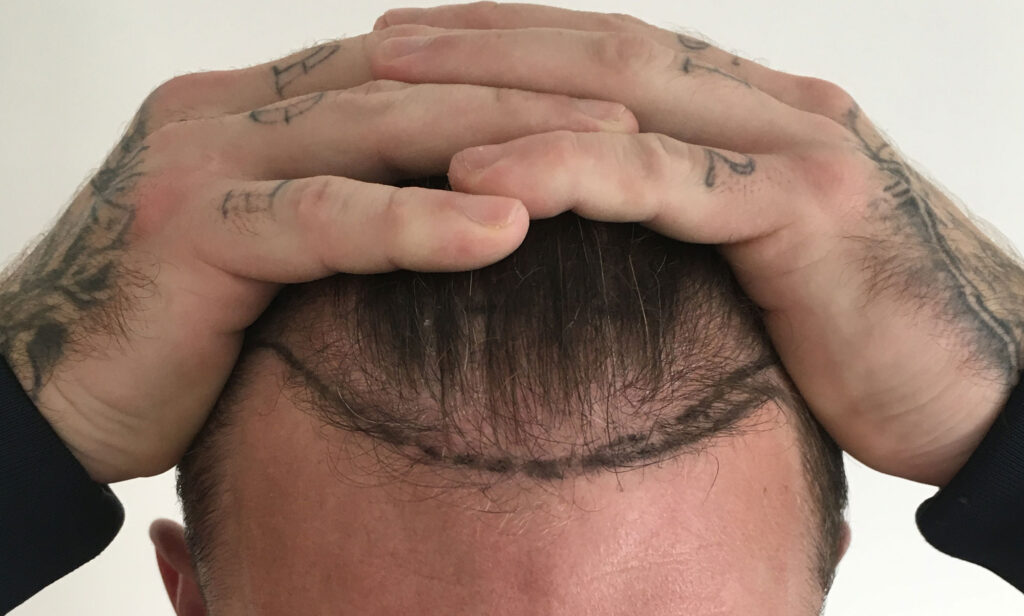
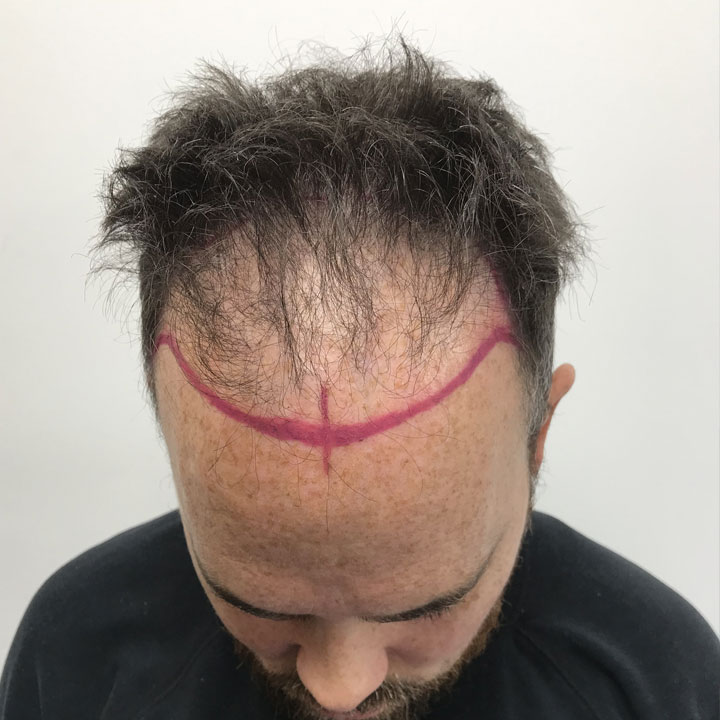
A receding hairline is one of the earliest patterns of male hair loss — and it is the most common. It starts mainly at the temples, where hair density reduces and the hairline shifts backwards, creating more forehead over time.
Clinically, this pattern aligns with early stages of male pattern baldness. On the Hamilton–Norwood scale, recession usually begins at Norwood stage 2, which is defined by visible temple recession without significant crown thinning.
When hair loss starts in the late teens or early twenties, it is more likely to be genetically driven and progressive.
In practical terms, a receding hairline is identified by the ‘M’ shape rather than hair fall. Daily shedding often stays within a normal range of 50–100 hairs, but the frontal hairline becomes uneven and thinner at the edges. You’ll notice the hair at the temples produces finer, shorter hairs before those follicles stop producing hair altogether.
This is different from temporary shedding.
Once temple follicles begin to miniaturise, regrowth without treatment is unlikely, and recession tends to worsen slowly over time.
What Thinning at the Crown Looks Like
Crown thinning affects the vertex of the scalp, which sits at the highest point of the head. This area is particularly sensitive to DHT, making it one of the most common locations where male pattern hair loss begins.
On the Hamilton–Norwood scale, crown thinning is typically classified from Norwood stage 3 Vertex onwards, where hair is thinner before a clearly defined bald patch forms.
In the early stages, hair is still present but spaced further apart, making the scalp more visible.
Crown thinning is often first noticed under bright or overhead lighting, where reduced hair density makes the scalp more visible. This is not usually due to increased shedding. Daily hair fall often remains within the normal range of 50–100 hairs, while the issue is a gradual reduction in follicle output.
Unlike hairline recession, crown thinning can spread outward in a circular pattern. Over time, this area may connect with frontal hair loss, but this won’t happen in all cases.
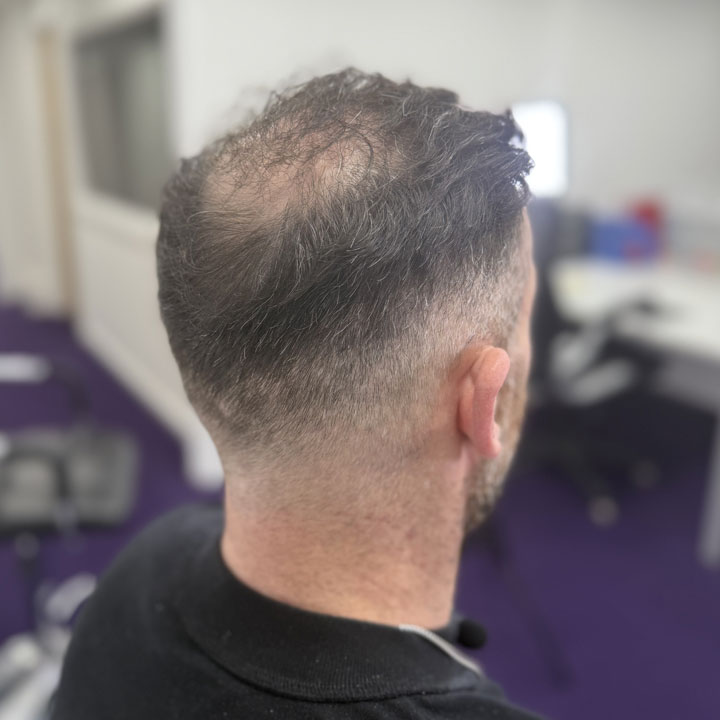
In fact, many men experience prolonged crown thinning without significant hairline change.
Because follicles in the crown tend to thin gradually rather than shut down suddenly, this area often responds well to early non-surgical treatments aimed at improving follicle activity and scalp health.
When to Act on Hair Loss Changes
Hair loss is worth addressing when you see these ongoing changes. That usually means a receding hairline that continues to move back, a crown that looks progressively thinner or a clear drop in density that lasts six months or more.
At that point, hair loss is no longer temporary shedding and is usually a sign of shrinking follicles, which is the process that leads to permanent loss if left unmanaged.
Non-surgical treatments are most effective while follicles are still producing hair:
- Plasma hair thickening injections are used to stimulate weakened follicles and slow further miniaturisation, particularly in the crown and frontal areas. This treatment is also used following a hair transplant to aid with regrowth.
- LLLT is typically used to support follicle activity and scalp circulation in early thinning.
These treatments do not create new hair. What they do is help protect and strengthen hair that is still present — which is why timing matters.
When an area has stopped producing hair altogether, non-surgical options are unlikely to restore density.
In these cases, a FUE hair transplant should be considered. Transplants relocate healthy follicles from the donor area into thinning or bald areas and are usually planned once hair loss patterns have stabilised with no active shedding.